Storm Damage Tree Cleanup in Greenville: Fallen Trees, Hanging Limbs and Debris Haul-Off
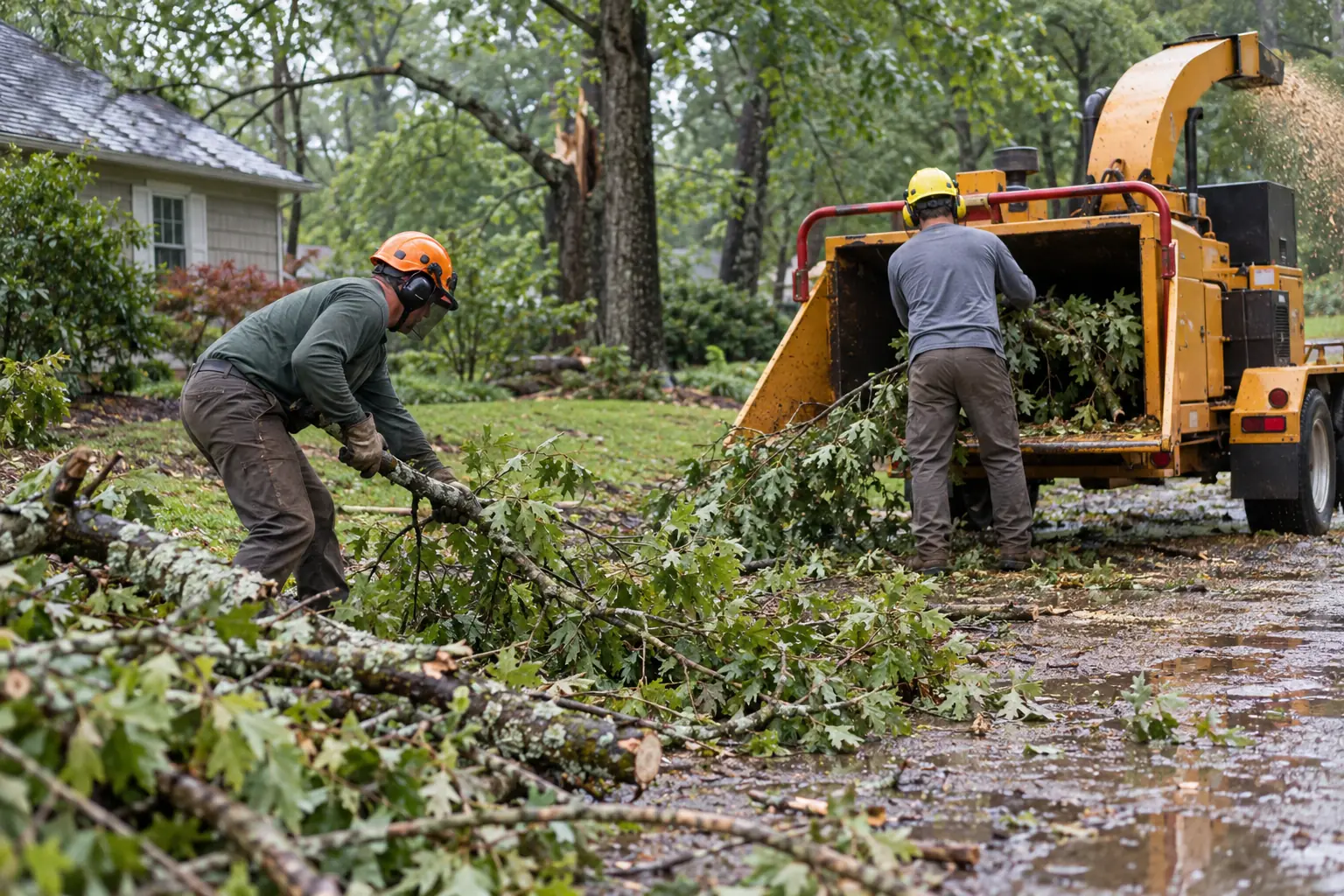
Storm damage tree cleanup in Greenville covers 3 jobs after the wind stops: cutting down broken and hanging limbs, sectioning fallen trunks, and hauling the debris away or stacking it for city or county pickup.
Our crew and partner arborist schedule this work after the emergency calls are cleared, so a yard full of limbs is priced as planned work rather than as an after-hours callout.
At a glance
- Emergency first: a tree on a house, car or power line goes to the emergency line, not the scheduled queue.
- Scheduled work: hanging limbs, fallen trunks in open yards and brush piles.
- Inside city limits: vegetative debris goes neatly at the curb, with no bags, trash or construction material mixed in.
- County routes: county crews run post-storm routes for loose limbs placed near the road.
- Insurance: photos before any cutting, and an itemized invoice after.
Storm Damage Tree Cleanup in Greenville: What the Crew Handles
Storm damage tree cleanup in Greenville starts with hanging limbs, because a broken branch caught in a crown can drop days after the wind stops, and then moves to fallen trunks and brush.
- Hanging limbs: broken tree limbs still caught in a crown are cut down first, from a bucket truck or by a climber.
- Fallen trunks: trunks in open yards are cut into sections that a truck or a curbside crew can move.
- Torn stubs: ragged breaks on limbs that stay are cut back to a clean point just outside the branch collar.
- Brush and logs: limbs are chipped and hauled away, or cut and stacked at the curb for public pickup.
- Split or uprooted trunks: these are assessed for tree removal instead.
Anything touching a power line waits for Duke Energy, and a tree resting on a building goes to emergency tree service, not the scheduled list. Never pull a hanging tree limb down from the ground, because a branch that is still attached can swing free without warning.
City Curbside Pickup vs County Routes vs Private Crews
Storm debris pickup depends on the address: the City of Greenville and unincorporated Greenville County handle curbside debris differently, and whole trees need a private crew either way.
| Where you live | What public crews take | How to report or drop off | When you need a private crew |
|---|---|---|---|
| Inside city limits | Vegetative debris placed neatly at the right-of-way | Email debris@greenvillesc.gov with address, size and a photo; general questions to 864-232-2273 | Whole trunks, logs too heavy to move, mixed debris |
| Unincorporated county | Loose limbs and vegetation placed near the road on post-storm routes | County disposal sites and transfer stations take self-hauled vegetative debris | Whole trunks, logs too heavy to move, mixed debris |
Storm debris piles at the curb should stay clear of mailboxes, utility poles and low wires. Do not mix bags, household trash or construction material into a storm debris pile, because a mixed pile can be skipped entirely. Our crews can cut and stack debris to curb rules for public pickup, which costs less than full haul-away.
Save or Remove: Assessing Damaged Trees
Storm damage tree cleanup in Greenville includes an arborist's call on each damaged tree, which falls into 1 of 3 groups: clean up the torn stubs, restore the crown over the next seasons, or take the trunk down.
A tree with a split trunk, a crack through the wood or a lifting root plate usually comes down. A damaged crown that kept a sound trunk can often be restored with careful pruning, removing no more than 25% of the live crown in one season and spreading the rest over later dormant seasons. The South Carolina Forestry Commission advises removing dead and broken limbs promptly, because broken wood is where decay starts. Our partner arborist marks every tree as clean up, restore or remove in the written scope, and restoration work follows the same standards as our tree pruning.
Insurance Paperwork After a Storm
Insurance claims move faster after a storm with three records: photos taken before cutting, an itemized invoice, and arborist notes on which trees were hit and why.
- Photos: each fallen or broken tree in place, plus any roof, fence or car it hit.
- Invoice: the address, the storm date, each trunk, the work done, hours, equipment and haul-away as separate lines.
- Arborist notes: which trunks came down in the wind versus which were already dead, so your agent or adjuster can see which is which.
Insurance money for fallen trunks has 1 South Carolina figure: the South Carolina Department of Insurance says some homeowners policies provide up to $500 for tree removal, and the limit applies to all the downed trees in one loss. Check your declarations page and debris-removal clause and ask your agent in writing; whether a carrier accepts a cost is the carrier's decision, so the invoice keeps work on a trunk that hit nothing on its own line. Do not cut up a fallen tree before the photos are taken, unless it blocks the only exit or threatens the house.
What the Work Costs
Storm damage tree cleanup in Greenville is priced by the work: the number of trunks, their size, how much brush must be hauled, and whether a bucket truck or crane is needed.
Removal runs $750 to $1,500 for most mid-sized specimens and $1,500 to $4,500 or more for a crane job, as our tree removal page shows, and our tree trimming cost guide covers pruning prices. Scheduling the work instead of calling it in as an emergency avoids the 25% to 50% same-day premium, while after-hours callouts can run 2 to 3 times the standard rate. Cutting and stacking debris for curbside pickup instead of full haul-away also lowers the bill.
Scheduling After Helene-Scale Storms
Hurricane Helene's remnants in late September 2024 brought down trees across the Upstate, and after a storm of that size, work runs in a clear order: trunks on structures first, then blocked driveways and hangers over walkways, then open-yard trunks and brush.
Booking a spot on the list early, and saying which group the damage falls into, gets the right crew to the right yard first.
Sources
Tree Pruning Greenville last reviewed on September 26, 2026 every fact on this page against city and county storm debris guidance, South Carolina Forestry Commission guidance, ANSI A300 pruning standards, a South Carolina Department of Insurance storm-claims release, and our own price pages, and you can contact us with a correction. Our methodology: each figure comes from a published source, and price ranges come from our own pricing pages. On-site assessments are done by our partner arborist James Martin, ISA Certified Arborist SO-356834A.
Questions After a Storm
Is Greenville, SC prone to natural disasters?
Greenville, SC is moderately prone to natural disasters, and flooding and severe winter storms are the most frequent threats. Flooding from heavy rain and flash floods is the most common natural hazard, ice storms and heavy snow bring down limbs and power lines, and severe thunderstorms bring destructive winds on a regular basis. Greenville is far inland and rarely takes a direct hurricane strike, but tropical remnants such as Hurricane Helene in 2024 still bring down trees across the area.
What is the cheapest way to get rid of yard waste?
The cheapest way to get rid of yard waste after a storm is to reuse or compost it on your property for free. Leave grass clippings on the lawn, heap leaves and small twigs into a compost pile, and stack larger limbs as clean vegetative debris for free public curbside pickup, inside city limits or on county routes.