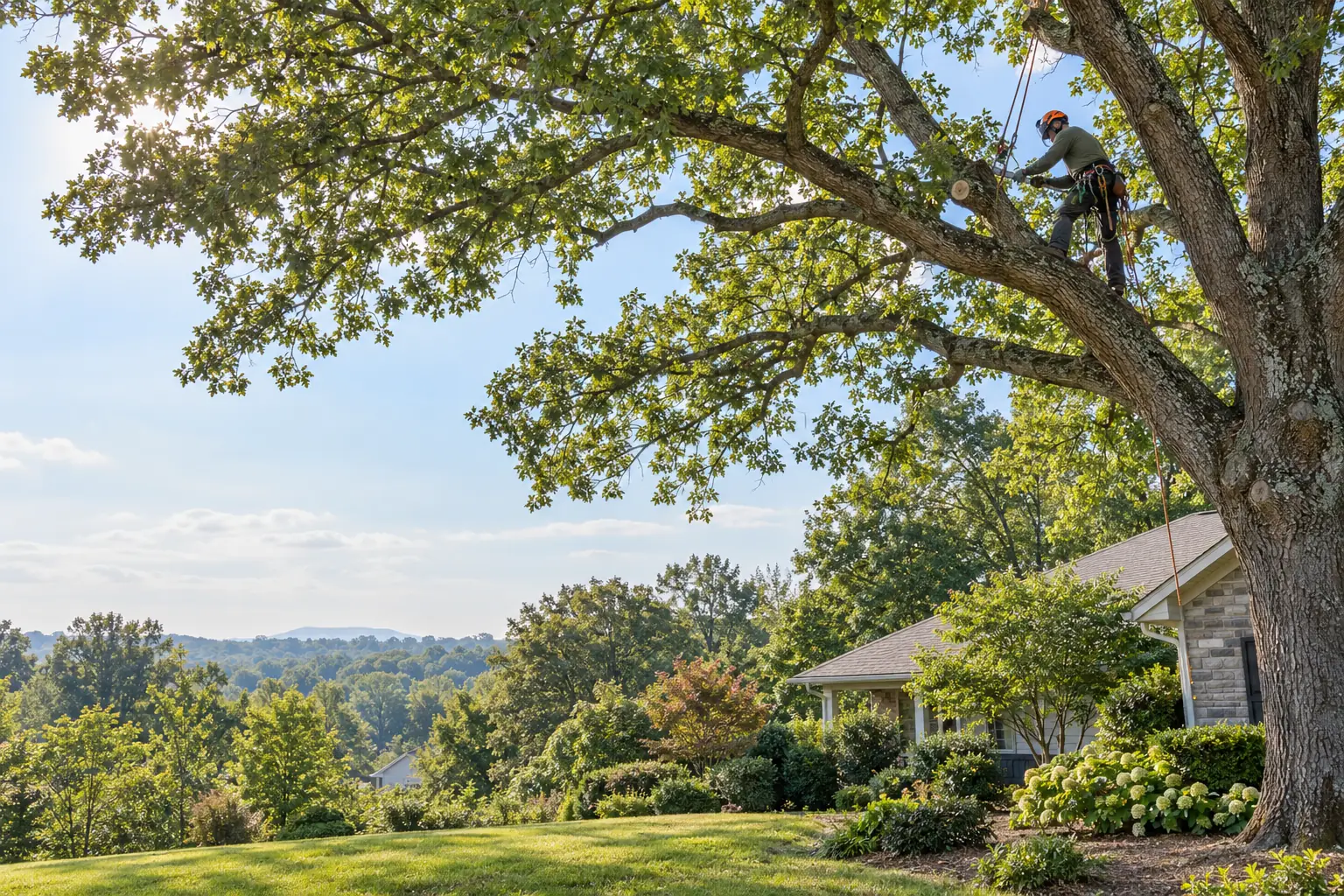
Tree pruning in Greenville, SC removes dead, crossing and overweight limbs with cuts placed just outside the branch collar, and a typical residential tree costs $315 to $700 to prune at 2026 national averages, with height, species and yard access setting the final quote.
ANSI A300 Part 1, the American National Standard for pruning, guides every cut by Tree Pruning Greenville: crews never top a canopy and take no more than 25% of the live crown in one visit.
At a glance
- Services: crown thinning, crown raising, crown reduction, deadwood removal, clearance cuts, structural pruning of young trees, crape myrtle and hedge trimming.
- Service area: Greenville plus Greer, Simpsonville, Mauldin, Taylors, Travelers Rest, Easley and Fountain Inn.
- Standard: ANSI A300 Part 1 cuts, no topping, 25% live-crown limit per visit.
- Typical price: $315 to $700 per tree at 2026 national averages; $75 to $400 for small ornamentals under 25 feet.
- Best window for shade trees: late winter, February to early March; oaks November through February only.
- Estimate: free on-site estimate with a written scope before any work starts.
Tree Pruning in Greenville, SC: Eight Services
Tree pruning in Greenville, SC covers eight services, from deadwood removal on one dogwood to crown reduction on a mature oak taller than 60 feet. Each service starts from an arborist's written scope, so a homeowner sees which limbs come off before the crew arrives.
- Crown thinning removes selected interior branches to cut wind load and let light reach the lawn, while the crown keeps its natural outline.
- Deadwood removal takes out dead, dying and broken branches, the limbs most likely to drop onto a roof, fence or parked car.
- Crown raising lifts the lowest limbs to clear driveways, sidewalks, roofs and play areas.
- Clearance cuts keep branches off roofs, gutters, chimneys and HVAC units.
- Crown reduction shortens long limbs back to healthy lateral branches, the accepted alternative to topping for an oak or maple that has outgrown its space.
- Structural pruning sets one central leader and well-spaced scaffold limbs in the first years after planting.
- Crape myrtle and hedge trimming shapes ornamentals without cutting crape myrtle trunks back to stubs.
- Storm-damage cuts remove split and hanging limbs after wind or ice and take torn stubs back to sound wood, while fallen trees go to storm damage cleanup.
Tree service in Greenville, SC covers more than pruning: the same crews handle tree removal, stump grinding, cabling, arborist assessments and emergency storm work, and each of those services has its own page with scope and price details, while all prices are collected in our cost guide.
How Every Cut Is Made: ANSI A300, No Topping
Tree Pruning Greenville bases every cut on ANSI A300 Part 1 and on the urban tree care guidance of the South Carolina Forestry Commission. Three rules decide how each branch comes off.
Cuts outside the branch collar
An arborist places a correct pruning cut just outside the branch collar, the ring of wrinkled bark where a limb joins the trunk. A flush cut into the collar opens trunk wood to decay, and a long stub left beyond the collar dies back. Heavy limbs get the three-cut sequence the Forestry Commission describes: an undercut about a foot from the trunk, a top cut a couple of inches farther out that drops the limb, and a final cut at the collar.
The 25% live-crown limit
Tree care crews remove no more than 25% of a canopy's live foliage in one visit, the ceiling Texas A&M Forest Service gives for mature trees. The Forestry Commission sets its outer limit at one-third of the crown, so the 25% rule sits on the cautious side of both published limits and leaves at least 75% of the leaf area working after every visit. A crown that needs more than 25% removed gets a reduction plan spread over two or three dormant seasons.
No topping, no wound paint
Tree topping does not make a canopy safer: the Forestry Commission warns that topping leaves weakly attached branches and large wounds, and Penn State Extension reports that topped trees become hazardous and drop branches later. Wound paint does not stop decay either. The Forestry Commission advises against painting cuts because research shows wound dressings do not prevent rot, so crews leave clean cuts to close on their own.
Upstate Pruning Calendar by Species
Tree pruning in Greenville, SC follows a species calendar: shade trees are cut in late winter or early spring before leaves emerge, oaks only from November through February, while spring bloomers such as dogwoods wait until their flowers fade. The table below was compiled by our team on September 26, 2026 from 8 published guides, led by the South Carolina Forestry Commission and Clemson Extension factsheet HGIC 1009; where two guides disagreed, the table shows the narrower window.
| Group | Best window | Window length | Avoid | Reason |
|---|---|---|---|---|
| Oaks | November through February only | Dormant season | April through October | Oak wilt beetles are active April through October |
| Other shade species (maples, elms) | Late winter, February to early March | About 5 weeks | August to October | Bare branches show structure; late cuts push growth that cannot harden before frost |
| Dead or hazardous limbs | Any month | Year-round | Waiting for the routine window | A damaged limb does not become safer in the wrong month for routine pruning |
| Crape myrtles | Mid-February to early March, before new growth | About 3 weeks | Heavy cuts after bud break | Crape myrtle flowers form on new growth |
| Dogwoods and other spring bloomers | Right after the flowers fade | About 4 weeks | Late winter | Winter cuts remove flower buds set the summer before |
| Southern magnolia | After flowering, only when needed | Varies | Heavy routine cuts | Magnolias need little shaping |
| Pines | Late winter to early spring, February to April | About 10 weeks | Cuts into bare wood without needles | New candles form in spring |
Late-summer cutting is not a safe off-season trim: cuts made from August through October push tender shoots that cannot harden before the first freeze. Crape myrtles do not need topping to bloom, because Clemson Extension notes that crape myrtle flowers are produced on new growth and the plant flowers even without any cuts.
Tree Trimming Near You: What a Visit Includes
Tree trimming for homes in Greenville, SC and the nearby towns starts with a free on-site visit, and every trimming job includes a written scope, the cutting work and cleanup of every cut branch, so two bids can be compared line by line. The visit runs in five steps.
- Walk-through: our partner arborist, James Martin, identifies each tree, its species and the limbs that need work.
- Written scope: the quote lists each tree, the cut type, the share of foliage to remove, cleanup and exclusions.
- Access plan: climbing, a pole saw or a lift, with lawns, beds and roofs protected under the work zone.
- Cutting: every cut follows ANSI A300 and the 25% live-crown limit.
- Cleanup: brush is chipped and hauled away, and logs are hauled or left cut to length on request.
| Part of the job | In the quote | Priced separately |
|---|---|---|
| Cuts to ANSI A300 | Yes | — |
| Chipping and haul-away of brush | Yes | — |
| Rigging limbs over a roof or fence | Listed in the scope | Published price guides add 20% to 50%, as our tree trimming cost guide shows |
| Removal and stump grinding | — | Separate line items |
| Cabling and bracing | — | Separate line item |
| After-hours storm work | — | Emergency rate |
Why Upstate Homeowners Prune Before Hurricane Season
Tree pruning in Greenville, SC before hurricane season removes the dead and overextended limbs that fail first in Upstate wind and ice storms. Our crews do that work in the late-winter window, and dead or hazardous limbs come off in any month.
Deadwood removal and crown thinning lower storm risk the most, because dead wood breaks without warning and a dense crown catches more wind. Booking that work in February or March also avoids the post-storm backlog, when Upstate crews are tied up with cleanup.
A limb already hanging over a house, or a tree resting on a roof, is emergency work rather than routine pruning and goes to emergency tree service instead.
Tree Pruning in Greenville, SC: Neighborhoods and Towns We Serve
Tree care crews cover the City of Greenville and 7 nearby towns: Greer, Simpsonville, Mauldin, Taylors, Travelers Rest, Easley and Fountain Inn. Crews also work in Five Forks, Powdersville, Piedmont, Berea and Wade Hampton by request. Town pages cover local details for Simpsonville and Greer.
Inside the city, crews work in established neighborhoods including Augusta Road, North Main, Alta Vista, Gower Estates, Sans Souci, Parkins Mill and the Paris Mountain area. Each town and neighborhood page lists local job notes and the species crews cut most often there.
When Tree Pruning Is Not the Right Fix
Tree pruning in Greenville, SC is the wrong tool in four situations, and a written scope will say so instead of quoting the work.
- Tree limbs within 10 feet of a power line: OSHA rules allow only qualified line-clearance crews to work that close to energized lines, so the utility or a line-clearance contractor handles those limbs.
- A fix that needs more than 25% of the live crown removed: a crown that needs 45% taken off gets 2 dormant seasons of reduction at 22.5% each, inside the 25% limit, or a removal assessment if the structure cannot be saved.
- A limb from a neighbor's yard: South Carolina has no statute that clearly grants a right to trim a neighbor's overhanging branches, and S.C. Code Section 16-11-520 makes willful injury to another person's tree a crime, so the scope calls for the neighbor's written permission first and no cuts past the property line.
- A cosmetic trim requested in August, September or October: the work waits for the late-winter window unless a limb is dead or hazardous.
Hiring an Insured Tree Trimming Company in Greenville
Should tree trimmers be insured? Ask any tree trimming company in Greenville, South Carolina for proof of general liability and workers' compensation coverage before work starts: Purdue University's forestry extension tells homeowners to require proof of liability insurance, and University of Arkansas storm guidance says to make sure a crew carries liability and workers' compensation coverage before it begins. Google search summaries say South Carolina has no general state license for tree trimming or removal, and a business license alone does not prove a crew can cut correctly: ISA certification requires passing an exam on biology, cutting practice and safety.
Four checks separate a qualified company from a door-to-door crew:
- Insurance: the tree company's certificate of insurance for general liability and workers' compensation, sent directly by the insurance agent.
- Credential: an ISA certification that can be looked up on the ISA credential search.
- Scope: a written scope that names ANSI A300 and rules out topping.
- Identity: a local address and phone number that match across the company's listings.
Sources and Standards Behind This Page
Tree Pruning Greenville (TreePruningGreenville.com) is a local tree pruning and tree care service, and on-site assessments are done by our partner arborist James Martin, ISA Certified Arborist SO-356834A.
Tree Pruning Greenville last reviewed on September 26, 2026 every fact on this page against these sources, and you can contact us with a correction. Our methodology: each figure comes from one of the published sources below, and where two sources disagree, both values are shown:
- ANSI A300 Part 1, the American National Standard for pruning.
- The ISA credential search of the International Society of Arboriculture.
- SCFC planting and care guidance from the state Forestry Commission on cuts, timing, topping and wound dressings.
- Clemson Extension factsheet HGIC 1009 on crape myrtles.
- Texas A&M Forest Service young-tree guide on the 25% crown limit.
- Penn State Extension on the cost of topping.
- OSHA rules for work near overhead power lines and S.C. Code of Laws Section 16-11-520.
- Purdue University Forestry and Natural Resources extension and University of Arkansas System Division of Agriculture storm guidance on hiring an insured crew, plus Google's AI search summaries, labeled where used.
Pruning Questions from Upstate Homeowners
What is the difference between trimming and pruning?
Trimming controls size, shape and clearance, while pruning removes specific branches to improve health and structure. Most jobs mix both, so one written scope covers clearance cuts, deadwood and structural cuts together.
What months should you avoid for pruning?
August, September and October are the months to avoid for routine pruning. Cuts in late summer and early fall push new growth that cannot harden before winter, so only dead or hazardous limbs come off in that window.
How often do mature shade trees need a trim?
Mature shade trees usually need a visit every 3 to 5 years, and young ones need structural cuts every 1 to 3 years. Fast-growing species and limbs over a roof may need a shorter cycle.
What is included in tree services?
Tree services cover trimming, removal, stump grinding, cabling and bracing, storm cleanup and health assessments. A quote lists which of those a job includes and prices the rest as separate lines.
What is a professional tree pruner called?
A professional tree pruner is called an arborist; the ISA credential shows the person passed the International Society of Arboriculture exam and keeps it current with continuing education. Line-clearance crews that work near power lines are a separate, utility-qualified specialty.
Are you supposed to tip a tree service company?
Tipping a tree service crew is optional, because the quoted price already covers labor and cleanup. Homeowners who want to thank a crew often offer cold drinks on a hot day or leave a review that names the crew leader.
What does the law say about trimming a neighbor's tree?
South Carolina law on tree trimming gives no clear statutory right to cut a neighbor's overhanging branches, and S.C. Code Section 16-11-520 makes willful cutting or injury of another person's trees a crime. The safe practice is written permission from the neighbor before any cut, and no cuts past the property line or on the trunk itself.