Crape Myrtle Trimming in Greenville, SC: Tree Form, Timing and Bark Scale Care
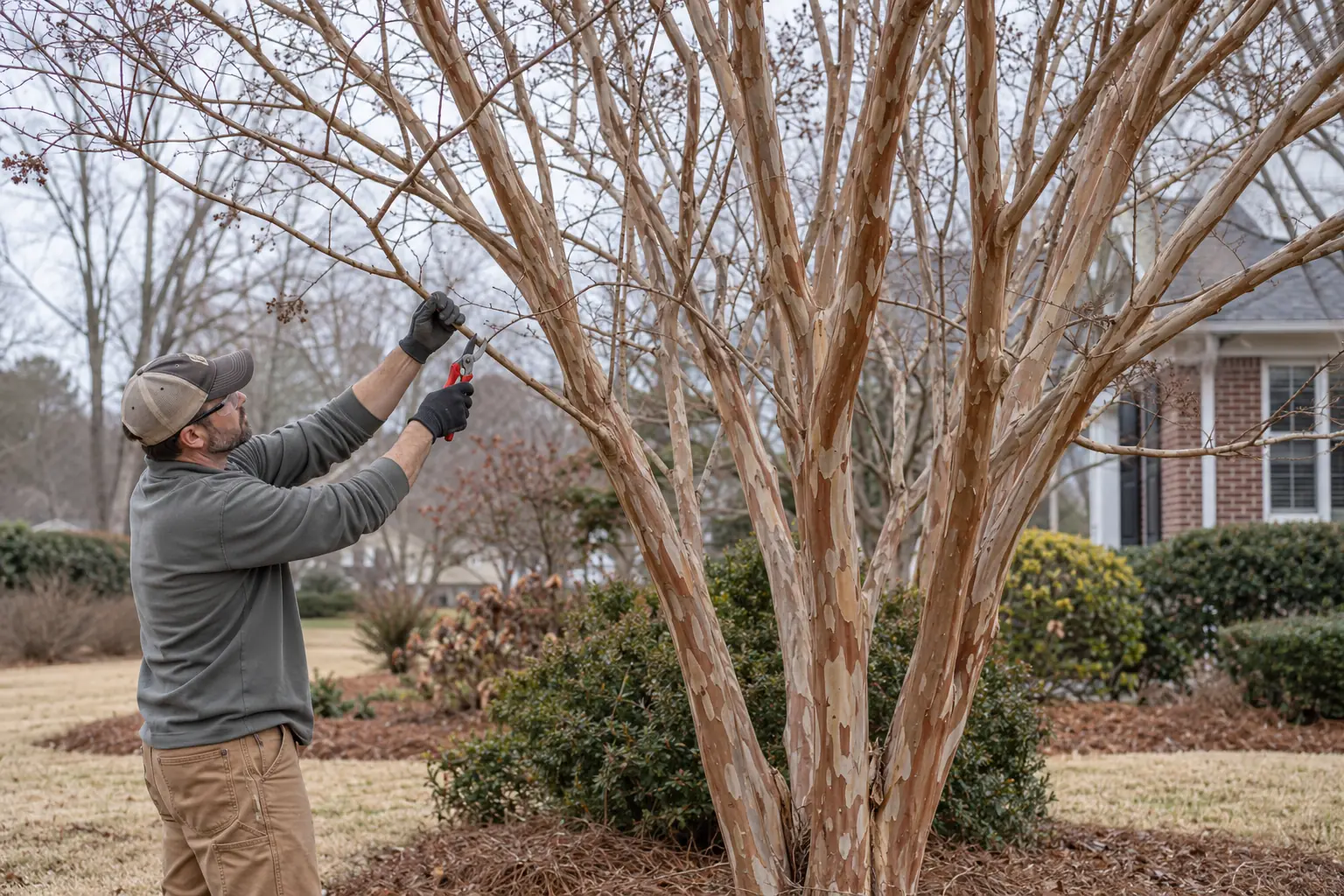
Crape myrtle trimming in Greenville, SC keeps 3 to 5 strong trunks and the natural vase shape: thin the crown, limb up the trunks and remove crossing branches in late winter, instead of topping the tree into knobby stubs.
Our partner arborist, James Martin (ISA Certified Arborist SO-356834A), handles on-site assessments for our Greenville crews; our crews quote this work per tree or per row after a free on-site visit, and every cut follows Clemson Extension's pruning factsheet for the plant (also spelled crepe myrtle) and the ANSI A300 standard.
At a glance
- Best time to trim: late winter, February to early March, while the plant is dormant.
- Blooms: flowers form on the current season's growth, so light pruning does not cost you flowers.
- Tree form: 3 to 5 strong trunks, lower limbs removed to one-third or halfway up.
- No topping: hard cuts leave weak knobs on otherwise healthy trees.
- Black trunks: sooty mold on the bark is the sign of bark scale.
Our Crape Myrtle Pruning Service
Our crape myrtle pruning service is a 5-step visit for yard trees, shrub types and HOA rows, quoted in a written scope after a free on-site look.
- Crown thinning: branches that rub or grow into the center of the canopy are removed to let in light and air.
- Trunk selection: a plant grown as a small tree keeps its 3 to 5 strongest trunks, and the rest are cut at ground level.
- Limbing up: lower side branches come off to one-third or halfway up the plant's height as the trunks mature.
- Clean cuts: each cut goes to a side branch or just outside the branch collar, never to a stub, and no more than 25% of the live crown comes off in one visit.
- Seed heads: removed in late winter only where they are within reach, cut just above a side bud.
Trimming debris is chipped and hauled away, and trunk washing for bark scale can be added to the same visit.
Crape Myrtle Trimming in Greenville, SC Without Crape Murder
Crape myrtle trimming in Greenville, SC should take wood from the inside and the bottom of the plant, not from the top, because topping every trunk at the same height does nothing for the flowers.
Pruning is optional for a plant with room to reach its mature size. Clemson Extension notes that the plant blooms well with no pruning at all and that severe cuts do not bring more flowers; topping only trades a graceful tree for a flush of thin shoots from knobby stubs. An arborist sees these topped stubs on streets across the Upstate every spring. The same no-topping rule applies to all our tree pruning.
When to Trim a Crepe Myrtle Bush or Tree
Crepe myrtle pruning is best done in late winter, from February to early March, so the best time to trim a crepe myrtle bush or tree is while it is dormant and leafless and the branch structure is easy to see.
| Time of year | What to cut | Why |
|---|---|---|
| February to early March | Structure: extra trunks, low limbs, crossing branches, seed heads | Dormant wood, cuts close before spring growth |
| Summer, right after the first flowers fade | Spent flowers on small shrub types | Can bring a second bloom |
| Any time | Dead, broken or damaged branches | Corrective pruning when a problem shows |
| Late summer through fall | Avoid heavy cuts | New shoots can be damaged by the first frost |
How to Trim a Shrub Type
To trim a crape myrtle shrub, the dwarf or semi-dwarf type, you need 3 kinds of cuts: twiggy growth back to lower side branches, dead wood at its base, and spent flowers after the first bloom.
Where a large plant sits in a spot meant for a low shrub, Clemson Extension lists 2 options: replace it with a dwarf cultivar, or cut the stems back to about 6 inches above the ground each year. Severe pruning will not kill a healthy plant, but choosing a cultivar whose mature size fits the spot is the only way to avoid yearly hard cuts.
Tall Plants Near Houses and Wires
Crape myrtle trimming in Greenville, SC for a tall plant next to a house should use clearance cuts, not topping: limb up lower branches for people and cars, lift limbs above the roofline of a single-story home, and remove one major trunk when the plant crowds the wall.
Topping a crepe myrtle is a last resort for an old specimen that must fit a tight space. Limbs near a power line are the utility's job, because OSHA allows only line-clearance crews within 10 feet of an energized line. An unwanted plant can be taken out with tree removal, but it resprouts from the stump and roots, so the stump has to be ground or the sprouts cut back for a season or two.
Bark Scale: Black, Sooty Trunks
Crepe myrtle bark scale is the cause of black, sooty trunks: the mold grows on honeydew from white or gray felt-like scale insects clustered in bark cracks and branch crotches.
Crepe myrtle bark scale was first found in the United States near Dallas, Texas, in 2004 and has spread across the Southeast, including South Carolina. Extension guidance combines 2 steps: scrub trunks with a soft brush and mild soapy water to remove scale and mold, and apply a systemic insecticide such as imidacloprid or dinotefuran as a soil drench in spring or early summer. Follow the label closely, because the flowers draw bees. Our crew can wash trunks during a winter pruning visit, and a soil drench applied for hire needs a licensed pesticide applicator.
HOA Entrances and Commercial Rows
Crape myrtle trimming in Greenville, SC for HOA entrances and commercial rows should be quoted per tree and per row, so a board can budget the whole entrance in one line and see what each tree costs.
The written scope lists the number of plants, their size class (shrubs, small trees or large trees), the trunk count, haul-away, and whether trunk washing for bark scale is included. Working a whole row in the same late-winter visit keeps the plants matched in height and form. Market prices for other pruning work are in our tree trimming cost guide.
Sources
Tree Pruning Greenville last reviewed on September 26, 2026 every fact on this page against Clemson Cooperative Extension's pruning factsheet HGIC 1009, Extension guidance on bark scale, OSHA line-clearance rules and ANSI A300, and you can contact us with a correction. Our methodology: each figure comes from a published source. South Carolina residents can also reach Clemson's Home & Garden Information Center at 1-888-656-9988. On-site assessments are done by our partner arborist James Martin, ISA Certified Arborist SO-356834A.
Pruning Questions
How do you tell if a landscaper is committing crape murder?
A landscaper is committing crape murder when the thick trunks of a crape myrtle are sawn through at the same height each winter, leaving knobby stubs that push out clusters of thin shoots, instead of whole branches being removed back to a side branch or the trunk.
How do you shape a crepe myrtle tree?
To shape a crepe myrtle tree, remove suckers and lower branches from the base up to one-third or halfway up the plant's height, clear out crossing and inward-growing branches, and keep 3 to 5 strong, straight trunks, cutting competing shoots at ground level; prune in late winter while the tree is dormant, and never chop off the main trunks.
Can you cut crepe myrtles back now?
You can cut crepe myrtles back in late winter, from February to early March, before new growth starts; from late summer through fall, hard cuts can push tender shoots that frost damages, while dead or broken branches can come off any time.
What is the best insecticide for crepe myrtle bark scale?
The best insecticide for crepe myrtle bark scale, according to Extension guidance, is a systemic product with imidacloprid or dinotefuran applied as a soil drench in spring or early summer, combined with scrubbing the trunks with soapy water to remove the scale and the black mold.