Certified Arborist in Greenville, SC: Tree Risk Assessments, Reports and Pre-Purchase Inspections
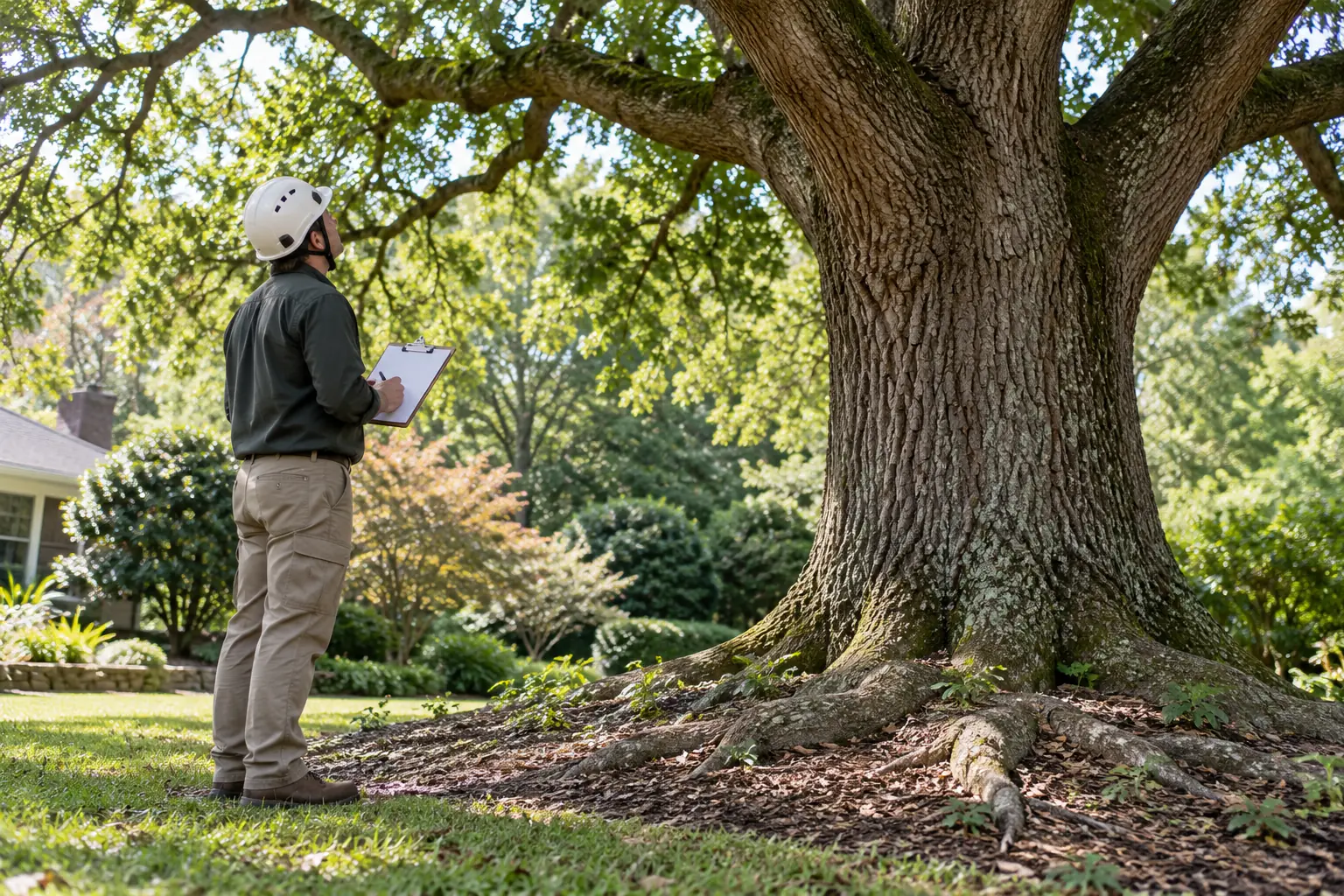
A certified arborist in Greenville, SC inspects trees for risk, health and value and puts the findings in writing; a basic visit typically costs $75 to $250, and a written tree risk assessment $150 to $700 for most homes.
Our partner arborist, James Martin, ISA Certified Arborist SO-356834A based in Greer, handles every assessment and report on this page; you can confirm the credential on the ISA credential search or on his digital ISA certificate, valid through June 30, 2029.
At a glance
- Credential: ISA certification, which Google search summaries say is kept current with continuing education units.
- Risk assessments: Level 2 basic assessments, rated low, moderate, high or extreme.
- Reports: a written assessment you can share with whoever asks for one.
- Appraisals: not offered; a consulting arborist handles tree valuation.
- Fees: quoted before the visit, and free when the visit is an estimate for tree work.
Certified Arborist in Greenville, SC: What a Visit Includes
A visit from our certified arborist in Greenville, SC is a walk-around inspection of each tree from the root flare to the crown, with the findings, photos and recommendations written down.
- Root flare and roots: the arborist checks for soil heave, cut or girdling roots, fungal fruiting bodies at the base.
- Trunk: cracks, cavities, seams, lean and signs of decay.
- Branches and crown: weak unions, deadwood, hangers and past topping cuts.
- Site and targets: the house, driveway, play areas and lines a failure could hit.
- Tools: a mallet for sounding, a probe for cavity depth, and binoculars for the upper crown.
- Leaves and bark: yellowing, leaf spots, early leaf drop, oozing sap, sawdust or boring holes that point to tree disease or insects.
An arborist assessment tells you three things: what is wrong, how likely it is to fail, and what to do about it, from no work at all to tree pruning, cabling, or removal.
Tree Risk Assessment Levels 1, 2 and 3
A tree risk assessment by a qualified arborist identifies, analyzes and rates the risk a tree poses: how likely a tree part is to fail, how likely it is to hit a target, and how severe the consequences would be.
An arborist uses 3 levels of tree risk assessment. A Level 1 limited visual assessment is a quick walk-by or drive-by check for obvious hazards across large areas, such as HOA common areas or property lines. A Level 2 basic assessment is a detailed 360-degree ground-based inspection of the buttress roots, trunk, branches, crown and site with a mallet, probe and binoculars. A Level 3 advanced assessment follows a Level 2 when a defect needs measuring, with specialized equipment such as resistance drilling or sonic tomography.
Level 2 vs Level 3 tree risk assessment, or basic vs advanced, comes down to tools and depth: an arborist completes a basic assessment from the ground with simple tools, while an advanced assessment measures internal decay, root condition or strength with specialized equipment and costs more. Basic findings are recorded on the ISA Basic Tree Risk Assessment Form, the standard form taught in the Tree Risk Assessment Qualification course, and each tree gets a rating of low, moderate, high or extreme.
Our partner arborist works at Level 2; when a defect needs a Level 3 test, the report names the test and why. An extreme rating goes straight to emergency tree service, and a high rating usually leads to pruning or tree removal.
Sounding and Resistograph Tests for Trunk Decay
Arborist sounding means tapping the trunk with a rubber or wooden mallet and listening: a solid trunk rings, while a dull or hollow tone points to decay or a cavity behind the bark.
A resistograph test for trunk decay drills a thin needle into the wood and graphs its resistance; a drop in the graph marks decayed or hollow wood, and the readings show how much sound wood remains. Sonic tomography sends sound waves between sensors around the trunk to map decay across a whole cross-section. Both are Level 3 tools, used when sounding finds a problem that has to be measured.
Tree Risk Assessment Qualification (TRAQ)
Tree Risk Assessment Qualification, or TRAQ, is the ISA credential that trains an arborist in a standard, systematic method for tree risk assessments, and an arborist who holds it is Tree Risk Assessment Qualified.
The qualification takes a 2-day course and a half-day written and field exam. Ask your HOA or insurer in writing what they need from a report, and we say upfront when a job needs a TRAQ-qualified assessor.
Arborist Reports for HOAs, Insurers and Home Purchases
An arborist report is a written assessment that states which trees were inspected, what was found, the risk rating, and the recommended work.
| Who asks | What the report answers |
|---|---|
| HOA or architectural committee | Whether removal or heavy pruning is justified |
| Homeowners insurer | Whether a tree was storm-damaged or already dead |
| Home buyer | Which trees near the house need work before closing |
A typical arborist report covers the property and date, a tree list with species, trunk diameter and location, the defects found with photos, the risk rating, the recommended work with a timeline, and the arborist's credential number. Detailed written reports typically cost $150 to $700.
Pre-Purchase Tree Inspections
A pre-purchase tree inspection by an arborist fits inside a buyer's due-diligence window, because a Level 2 visit on a typical lot takes about an hour and the written report follows.
Ask your home inspector what their agreement covers; the arborist inspection covers every tree within striking distance of the house, roots near the foundation and driveway, leaning or decaying trunks, and limbs over the roof. The report gives a price range for any work, which a buyer can use in negotiations.
Tree Appraisal
Tree appraisal in Greenville, SC puts a dollar value on a tree for a claim, a damage dispute or a construction loss, and it is a separate tree service from a tree risk assessment.
Our company and our partner do not do tree appraisals; a consulting arborist handles that work. A Level 2 report from our partner can still record the species, trunk diameter and condition of each tree for your adjuster or attorney.
Arborist Fees
An arborist in the Greenville market charges about $100 to $250 an hour, a basic visit costs $75 to $250, and a written tree risk assessment typically runs $150 to $700 for most homes.
Local summaries put Greenville tree risk assessments at $250 to $600, depending on whether a formal written report is needed. Our fee for a stand-alone Level 2 assessment or report is quoted before the visit, and an estimate visit for pruning or removal is free.
Sources
Tree Pruning Greenville last reviewed on September 26, 2026 every fact on this page against ISA certification and TRAQ requirements, ISA tree risk assessment best practices and the ANSI A300 standard, and 2026 fee summaries, and you can contact us with a correction. Our methodology: each figure comes from a published source, and where sources disagree, the range covers both.
Arborist Questions
What does TRAQ stand for?
TRAQ stands for Tree Risk Assessment Qualification, an arborist credential. TRAQ is a professional credential and training program created by the International Society of Arboriculture (ISA) to teach a standard way to evaluate tree risk; candidates pass a written exam and a field assessment.
What is the highest level of arborist?
The highest level of arborist is the Board Certified Master Arborist (BCMA), the top level of certification offered by the International Society of Arboriculture (ISA); Google search summaries say it requires at least 4 years as an ISA Certified Arborist and 5 years of practical experience. Numbered levels such as a Level 3 or Level 5 arborist are Australian qualifications, a Certificate III for hands-on climbing and pruning and a Diploma of Arboriculture for consulting; US arborists are not graded that way.
How long does it take to get arborist certified?
Getting arborist certified by ISA takes at least 3 years of full-time practical work experience in arboriculture or a degree in a related field, ISA's Rocky Mountain Chapter says, followed by a written exam of 200 multiple-choice questions; Google search summaries add that holders keep the credential by earning continuing education units.
How much does an arborist charge per hour?
An arborist charges about $100 to $250 per hour for assessments, reports and consulting, while a basic visit to look at a tree costs $75 to $250 and is often free when it is an estimate for pruning or removal.
How much does an arborist inspection cost?
An arborist inspection costs about $75 to $250 for a basic visit with a standard visual inspection and verbal advice, while a detailed written report runs $150 to $700, and many tree companies inspect for free when quoting pruning or removal.
What does an arborist assessment do?
An arborist assessment inspects a tree's roots, trunk, branches and site to find defects, rate the risk of failure, and recommend work, from no action to pruning, cabling or removal.
Do you offer arborist services across Greenville County?
Our arborist services, delivered by our partner arborist James Martin, cover all of Greenville County, including Greenville, Greer, Simpsonville, Mauldin, Taylors and Travelers Rest, with tree risk assessments, written reports and pre-purchase inspections of trees.
Can an arborist diagnose tree disease?
An arborist diagnoses tree disease and pests by checking the leaves for yellowing, brown spots, wilting or early drop, and the trunk and bark for deep cracks, oozing sap, sawdust or boring holes; for sick trees, Clemson Extension's Home & Garden Information Center is another local resource.
Is there a free arborist consultation?
A free arborist consultation is common when the visit is an estimate for pruning or removal, while a stand-alone risk assessment or written report is a paid visit quoted in advance.